
When a Story Leaves Your Hands

Opening Reflection
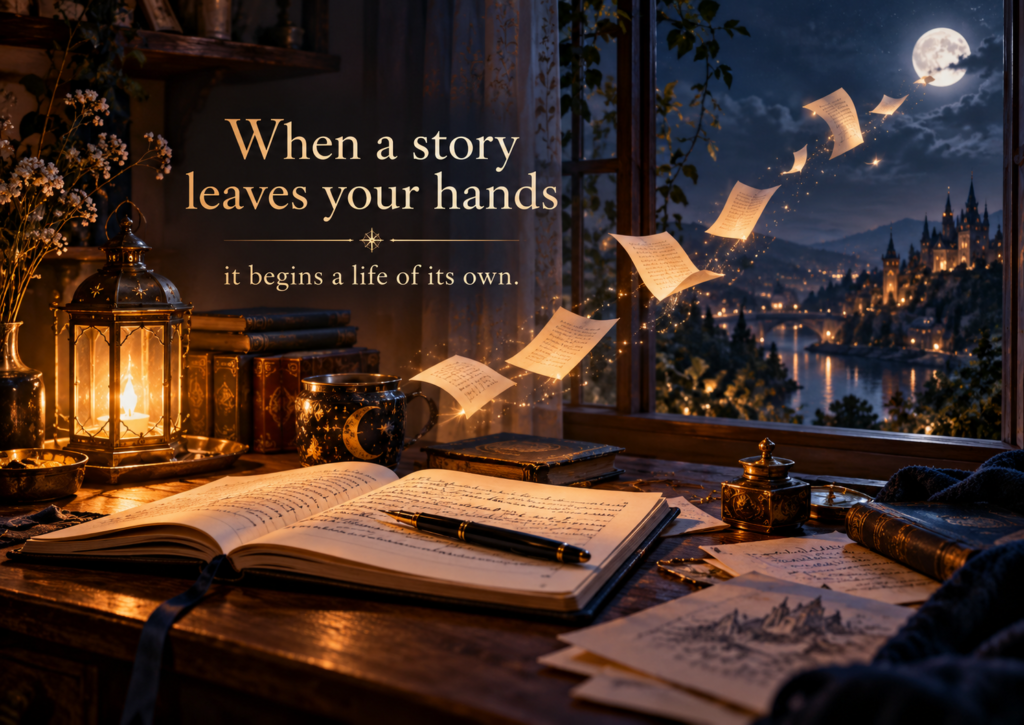
There is a strange moment in writing when something that has existed quietly in your own imagination becomes available to someone else.
Before that moment, the characters belong mostly to you. You know where they have been, what they are hiding, and which roads they have not taken yet. You can change a scene, rebuild a chapter, or tear down an entire piece of the world without anyone knowing it ever looked different.
Then you publish.
And suddenly the story begins having a life outside your own head.
Reflection
I’ve been thinking about that a lot lately.
Ledger of the Crown is now being released serially on Royal Road and Patreon, with new episodes going out three times a week.
That experience is different from the way I’ve been working on Aetherbound.
With Aetherbound, I’ve spent a long time inside the manuscript before asking readers to step into it. I’ve had room to draft, rethink, revise, discover contradictions, change direction, and return to earlier chapters with knowledge I didn’t have when I first wrote them.
Ledger asks something different of me.
The story is still moving forward while readers are already entering the world behind me.
And that changes the experience in ways I hadn’t fully appreciated before starting.
A story feels different once someone else is waiting for the next page.
When the Private Becomes Shared
Writing can be surprisingly private.
Even when you’re building enormous worlds filled with characters, history, conflict, and possibility, much of that work happens alone.
You spend enough time with the characters that they start to feel familiar.
You know the streets.
You know the rooms.
You know the things that haven’t happened yet.
But a reader doesn’t.
They arrive at the beginning with none of that history.
And suddenly I have to remember something that’s easy to forget while writing:
The reader can only know what I’ve actually put on the page.
They haven’t seen my notes.
They haven’t followed the conversations that led to a particular idea.
They don’t know which small detail will matter later.
They only have the story I’m giving them.
There’s something both intimidating and exciting about that.
Writing While the Door Is Open
Serialization introduces another interesting difference.
A finished novel gives the writer a long period where the doors remain closed.
You can rearrange the furniture before anyone arrives.
With a serial, the door opens much earlier.
Readers can begin exploring while you’re still building farther down the road.
That doesn’t mean writing without a plan. If anything, it has made me think more carefully about where the story is going and what each installment needs to accomplish.
But it also creates a different kind of energy.
There is a rhythm to knowing that another episode has a release day.
Monday.
Wednesday.
Friday.
The story keeps moving.
And so do I.
Two Different Ways of Building
Working on Aetherbound and Ledger of the Crown at the same time has made me appreciate that stories don’t all need the same creative process.
Aetherbound has benefited from patience.
It has needed revision, reconsideration, and the freedom to examine the structure from a distance.
Ledger benefits from momentum.
Its regular release schedule encourages me to keep looking forward—to discover the next conversation, complication, decision, or revelation.
Neither approach feels inherently better.
They’re simply different.
And I think I’m learning something useful from having both in my writing life at the same time.
One teaches me to stop and look again.
The other reminds me to keep walking.
What Readers Change
There is another part of releasing a story that has nothing to do with deadlines.
Readers bring something to a story that the writer cannot.
Perspective.
A character I think of one way may strike someone else completely differently.
A detail I considered small may become the thing someone remembers.
A question I expected readers to ask may pass unnoticed while something I barely considered becomes fascinating to them.
Once a story reaches another person, I don’t completely control what it means anymore.
And I think that’s a good thing.
Stories aren’t meant to remain sealed inside the imagination of the person who wrote them.
Eventually, someone has to open the door.
Final Thoughts
There was a time when Ledger of the Crown existed only as an idea.
Then it became notes.
Then scenes.
Then episodes.
Now it has readers.
I’m still discovering what that transition means.
But perhaps that’s one of the best parts of sharing creative work.
Finishing something isn’t the only moment when it changes.
Sometimes the biggest change happens when it leaves your hands and enters someone else’s imagination.
And from there, the story begins another journey—one the writer doesn’t get to take alone.
So I’ll end this entry with the question I’ve been thinking about myself:
Have you ever created something privately for a long time and then finally shared it? What changed once someone else could experience it?
Until next time…
Keep your lantern lit.
— Clifton C. Jackson
Keep the Stories Coming
The Journal is only one part of the journey.
Join The Lantern List for stories, behind-the-scenes glimpses, new worlds, and occasional notes from the writing desk—delivered directly to your inbox.
No noise. No clutter. Just stories worth carrying with you.