The Pace That Lets the Story Breathe.
Opening Reflection
For a long time, I thought progress was supposed to feel exciting.
A new idea arrives. A project begins. Pages come quickly. Everything feels possible because nothing has had time to become difficult yet.
But eventually the excitement settles.
The work remains.
And lately, I’ve been discovering that what happens after that point may matter even more than the beginning.
Reflection
There is something reassuring about reaching the point where a routine no longer feels new.
Not effortless.
Not automatic.
Just familiar.
When I began releasing Ledger of the Crown on a Monday, Wednesday, and Friday schedule, every release felt like another moving piece I needed to remember.
Write.
Prepare.
Post.
Keep moving.
Now, the rhythm is beginning to feel different.
Those days are becoming part of the landscape of the project rather than landmarks I have to constantly search for.
And that has made me think about what routine actually gives us.
It doesn’t make the work disappear.
It gives the work somewhere to live.
Sometimes consistency creates the space that inspiration needs.
When Progress Stops Being Dramatic
We tend to notice the obvious milestones.
The finished draft.
The publication date.
The new project.
The chapter that finally works.
But most of the work happens somewhere between those moments.
One scene revised.
One episode finished.
One problem solved.
One evening where you sit down and continue even though nothing particularly exciting happens.
Those days rarely feel important while you’re living them.
But collect enough of them and something begins to exist that wasn’t there before.
A manuscript.
A series.
A world.
Maybe even a career.
That’s one of the things I’m learning to appreciate more.
Not every writing day needs to become a story worth telling.
Sometimes it just needs to become another page.
Different Stories, Different Rhythms
Working on Ledger of the Crown alongside Aetherbound has made the differences especially clear.
Ledger asks for momentum.
Its serial format gives the work a pulse.
Monday.
Wednesday.
Friday.
The story keeps moving forward, and the routine encourages me to keep moving with it.
Aetherbound has asked something very different from me.
It has asked me to return.
To reconsider.
To revise something I thought I understood and discover that it needs another look.
One project teaches me to continue.
The other teaches me not to hurry.
I used to think those approaches contradicted each other.
Now I’m beginning to think they belong together.
There are times when a story needs momentum.
There are times when a story needs patience.
The challenge is recognizing which one you’re being asked for.
The Difference Between Fast and Sustainable
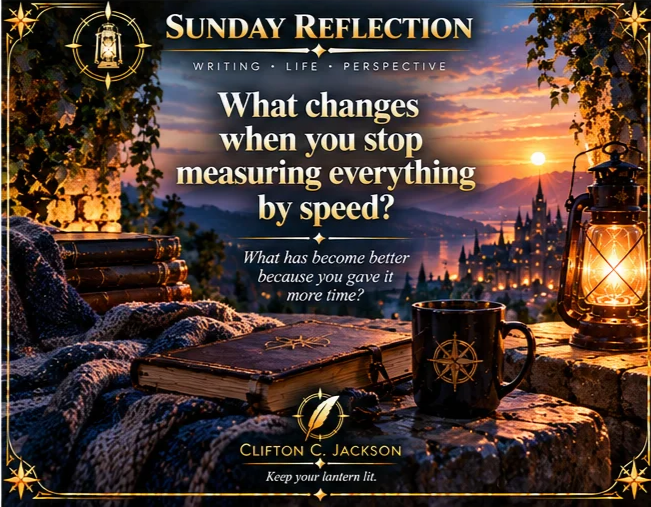
There’s an appeal to moving quickly.
Speed is easy to measure.
Three chapters instead of one.
Twenty pages instead of five.
A finished project instead of something still sitting on the desk.
But speed doesn’t necessarily tell us whether what we’re building can last.
Routine asks a different question.
Can I return tomorrow?
Can I keep doing this next week?
Can the work continue alongside everything else life requires?
Those questions have become more important to me lately.
Work gets busy.
Plans change.
Energy isn’t unlimited.
And creativity doesn’t exist in a separate world where those things stop mattering.
A routine that only works when everything else is perfect isn’t much of a routine.
The useful ones are the ones that survive ordinary life.
What Routine Leaves Behind
Maybe that’s what I’ve been appreciating most.
Routine rarely looks impressive from the inside.
It’s repetitive by definition.
You return to the same desk.
Open the same document.
Continue the same story.
But each return leaves something behind.
Another paragraph.
Another revision.
Another episode.
Another small piece of something much larger.
Eventually, you look back and realize that all those ordinary sessions accumulated into something you couldn’t have created in a single burst of inspiration.
That feels particularly important to remember when progress seems slow.
Slow doesn’t necessarily mean stalled.
Quiet doesn’t mean nothing is happening.
And routine doesn’t mean the work has stopped being creative.
Sometimes routine is what allows creativity to survive long enough to become something finished.
Final Thoughts
I’m still learning what kind of creative rhythm works best for me.
I suspect that will continue changing as the projects change.
But I’m becoming less interested in asking how quickly everything is moving.
Instead, I’m trying to ask:
Is the work continuing?
Is it becoming stronger?
Is the way I’m working something I can sustain?
Those answers may matter more than speed.
Because stories aren’t usually built in one extraordinary day.
They’re built across dozens of ordinary ones.
One page.
One episode.
One revision.
One return to the work.
Until eventually, all those small steps become something that lasts.
So I’ll leave you with the question I’ve been asking myself:
What has become possible in your life simply because you kept showing up?
Until next time…
Keep your lantern lit.
— Clifton C. Jackson
Keep the Stories Coming
The Journal is only one part of the journey.
Join The Lantern List for stories, behind-the-scenes glimpses, new worlds, and occasional notes from the writing desk—delivered directly to your inbox.
No noise. No clutter. Just stories worth carrying with you.